International rail conference sees 3 MOUs for clean energy, fleet modernization
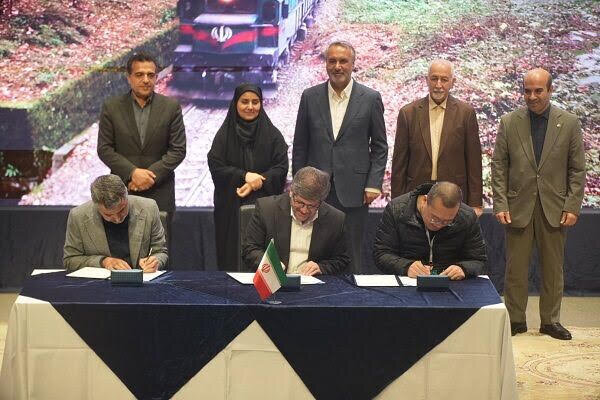
TEHRAN- Concurrently with the 19th International Rail Transport Conference, three cooperation memoranda of understanding centered on building solar power plants on railway lands, supplying 36 fully battery-powered locomotives, and refurbishing 24 out-of-service locomotives were signed in the presence of the Minister of Transport and Urban Development and a group of officials and rail industry figures.
According to an IRNA report, concurrently with the 19th International Rail Transport Conference, three cooperation and investment MoUs aimed at developing renewable energy, supplying fully battery-powered locomotives, and modernizing the rail fleet were signed in the presence of Farzaneh Sadegh, Minister of Transport and Urban Development; Mohammad Reza Rezaei Kuchi, Chairman of the Civil Engineering Committee of the Parliament; Abbas Soufi, Vice Chairman of the Committee; and Mohsen Tarztalab, Deputy Minister of Energy.
These MOUs were concluded between the Islamic Republic of Iran Railways and a group of institutions, companies, and investment and technology groups active in renewable energy and rail technologies. Their main axes are clean energy development, attracting private-sector investment, fleet modernization, and increasing the operational capacity of locomotives.
The first MOU was signed between the Islamic Republic of Iran Railways and the Renewable Energy and Energy Efficiency Organization (SATBA). It was concluded with the aim of providing the ground for private-sector participation in building solar power plants on non-operational lands of railway stations.
The second MOU was signed between the Islamic Republic of Iran Railways and Niruafarin Aras Energy Company with the aim of investing in, supplying, and operating 36 fully battery-powered locomotives for freight and passenger use. This MOU was signed with the participation of an Iranian consortium and a foreign consortium, and representatives of the participating parties attended the ceremony.
The third MOU was signed between the Islamic Republic of Iran Railways and an investor and technology group consisting of Sadid Fam and Rezvan Power Electronics Industries. Its subject is investment in refurbishing 24 out-of-service locomotives and returning them to the operational cycle.
These three MOUs were signed in line with linking investment and technology capacities with the needs of the country’s rail industry, centered on clean energy development, supplying a new fleet, and increasing the operational capacity of existing locomotives.
Chabahar rail connection to national network geopolitically important, corridors a priority: minister
The Minister of Transport and Urban Development, emphasizing the need to complete rail corridors and connect ports and production centers to the national network, cited the development of logistics infrastructure and the strengthening of regional cooperation as among the strategic priorities of the country’s transport sector.
According to an IRNA report, Farzaneh Sadegh said on Tuesday at the 19th International Rail Transport Conference, emphasizing the strategic position of rail transport in economic development and increasing the country’s resilience: “Developing this sector, in addition to reducing economic costs and energy consumption, helps increase productivity, improve safety, and strengthen national resilience. Therefore, it has a central place in the policymaking, planning, and actions of the Ministry of Roads and Urban Development.”
Referring to the importance of rail transport in crisis conditions, she added: “The continuity of transport of essential goods, production inputs, and strategic goods, as well as passenger movement, is necessary for maintaining the flow of life and economic activity in the country.”
The Minister of Transport and Urban Development, referring to the damage to the country’s rail infrastructure during the war, explained: “During the unjust war in which legal and international protocols were violated, the country’s infrastructure was also targeted. Damage to seven rail bridges showed how closely these infrastructures are tied to the country’s resilience and domestic connectivity.”
Sadegh, referring to the importance of connecting Iran’s rail network to neighboring countries, continued: “The rail network must support the country’s supply chain by relying on sustainable infrastructure, a ready fleet, and capable human resources. Achieving this goal also requires simultaneous attention to fleet development and modernization, infrastructure maintenance, removing network bottlenecks, and improving operational productivity.”
Completing rail corridors and utilizing Iran’s strategic capacity
The Minister of Transport and Urban Development, emphasizing Iran’s opportunities in international transport, said: “The country’s position at the junction of regional routes will turn into sustainable foreign-exchange income and economic prosperity when we can provide competitive, regular, and reliable services—so that cargo owners can confidently decide on the time, cost, and quality of transport via Iran.”
She cited the completion of rail corridors, active transport diplomacy, facilitation of border procedures, tariff coordination, and development of regular services as requirements for achieving this goal, and added: “The effective connection of ports, production centers, and logistics terminals to the rail network is also especially important, and private-sector transport and logistics companies are the country’s main partners in creating and maintaining competitive advantage.”
Sadegh, referring to the implementation progress of the Chabahar–Zahedan railway project, stated: “In autumn 2024, the rail connection operations from Khash to Chabahar via Zahedan began. Before that, the rail connection of Zahedan to Khash had been carried out by previous governments, but this route had not yet been connected to Chabahar Port, while the rail connection of Zahedan to Chabahar is of strategic and geopolitical importance.”
Appreciating the President’s support in securing resources for the Chabahar–Zahedan railway project, she stated: “Over the past two years, despite the country’s difficult conditions and the outbreak of war, about 40 trillion tomans have been secured and allocated for the Chabahar–Zahedan railway, and we hope this project will become operational within the next one or two months.”
The Minister of Transport and Urban Development considered the President’s continuous follow-up for railway development and connecting the rail network to ports a sign of the importance of this issue in the priorities of the 14th government, and said: “The events that occurred in the northern ports and the restrictions we faced in the southern ports revealed more than before the importance of rail connection of ports and the creation of alternative routes for cargo movement.”
She also referred to the operation and boost in activity of the Aprin logistics center over the past two years and considered the development of this center an effective measure in strengthening the country’s logistics capacity.
Removing bottlenecks, modernizing fleet, and expanding private-sector investment
Sadegh, emphasizing that increasing the share of rail transport in freight and passenger movement cannot be achieved merely by developing lines, said: “Achieving this goal requires balance among infrastructure capacity, fleet, and service quality. Electrification of rail lines is also one of the important policies in this area, which is being pursued with priority for high-traffic and strategic corridors.”
She added: “Success in electrification of lines requires coordination among line development, fleet supply, energy infrastructure, and operation systems, and cooperation between the transport and energy sectors is decisive in this regard.”
The Minister of Transport and Urban Development, referring to the need to use new technologies in the rail industry, explained: “Digitalization and artificial intelligence can be effective in managing network capacity, predicting equipment failures, planning maintenance, increasing safety, and improving services. Blockchain technology, in appropriate applications, can also help with transparency and tracking documents and transactions.”
Sadegh, stating that the criterion for using technology should be solving real problems and achieving measurable performance improvement, continued: “In the energy field, storage systems, modern power supply systems, and renewable energies have created new opportunities that should be used with precise technical and economic assessment.”
She considered the issue of supplying and ensuring the operational readiness of locomotives one of the important issues in the rail industry and said: “The shortage of traction power and the low availability of part of the diesel fleet have a direct effect on transport capacity and service quality. Over the past two years, this issue has been one of the main areas of follow-up by the Ministry Transport and Urban Development, the Railway Company, and the government, and with support for private-sector investors, the number of in-service locomotives and their operational readiness have improved somewhat; of course, these measures are still not enough and are being pursued seriously.”
The Minister of Transport and Urban Development, referring to the agreements and MOUs concluded with the private sector in the rail sector, said: “These investments are not limited merely to increasing the length of rail lines; rather, they also include identifying bottlenecks and main freight hubs and directing investment toward double-tracking and quadruple-tracking routes, removing network restrictions, and developing logistics centers and border terminals. Some of the MoUs in this area have also been concluded with neighboring countries.”
Sadegh, referring to the agreements to be signed on the sidelines of this conference, said: “Supplying fully battery-powered locomotives, refurbishing existing locomotives using battery-centric hybrid systems, and building solar power plants on railway lands are among the subjects of these agreements, which can provide the basis for linking investment and technology to respond to the needs of the rail industry.”
She appreciated the cooperation of the Ministry of Energy, SATBA, the Vice Presidency for Science, Technology, and Knowledge-Based Economy, investors and technology-owning companies, as well as the follow-up by the CEO and staff of the Railway Company, and added: “The formation of these cooperations shows that through synergy among executive bodies, universities, and the private sector, practical solutions can be found for the difficult issues of the rail industry.”
The Minister of Transport and Urban Development, emphasizing her ministry’s support for the effective presence of investors, said: “Developing the rail industry is not possible without the active participation of the private sector and the use of its financial and specialized capacities. Domestic and foreign universities and scientific centers also have a fundamental place in this path, and university-industry cooperation is expected to continue from the problem-definition stage through the design, testing, and evaluation of solutions.”
President stresses turning Iran’s geographical position into a sustainable transit advantage
The President, emphasizing the importance of an efficient and competitive network of transport and logistics infrastructure in turning the country’s geographical position into a sustainable advantage, added: “Completing rail corridors, connecting ports and production centers to the network, and expanding cooperation with neighboring countries can enhance Iran’s position in regional transit and provide the ground for increased trade exchanges and sustainable foreign-exchange revenues.”
According to a Tuesday IRNA report, Masoud Pezeshkian, in a message to the 19th International Rail Transport Conference, considered railway development an investment in the economic future and welfare of society and stated: “The progress of our great Iran requires infrastructures that support economic growth, preserve national resources, and improve the quality of life of the people. Rail transport is one of the most important of these infrastructures, which, by connecting production centers to domestic and international markets, reducing transport costs, and increasing the safety and sustainability of movement, can help strengthen production, develop trade, and increase the competitiveness of the country’s economy.”
The President, emphasizing the importance of an efficient and competitive network of transport and logistics infrastructure in turning the country’s geographical position into a sustainable advantage, added: “Completing rail corridors, connecting ports and production centers to the network, and expanding cooperation with neighboring countries can enhance Iran’s position in regional transit and provide the ground for increased trade exchanges and sustainable foreign-exchange revenues.”
Pezeshkian considered the future of rail transport dependent on the use of knowledge, technology, and innovation, and stating that smart network management, development of digital systems, electronic data exchange among the railway, customs, ports, and transport companies, and the use of new technologies in fleet maintenance must lead to increased safety, reduced transit time, and improved service quality, he emphasized: “It is expected that the country’s scientific and engineering community, in cooperation with industry and knowledge-based companies, will provide innovative and practical solutions for the priority issues and needs of this sector, and that executive bodies will provide the ground for utilizing these achievements.”
MA
Leave a Comment